

Table of contents
How to align procurement strategy with the organization
The procurement strategy will need to be tailored to the specific needs and requirements of an organization and the sector and environment in which it operates.
FREE WHITE PAPER
Reduce Total Cost of Ownership (TCO) with the Kraljic Matrix
How to arrive at a procurement strategy?
Procurement strategy varies from company to company and depends on an organization’s size and business, culture and leadership, among other factors. A large multinational company will have a very different procurement strategy than a small, local business.
How can organizations ensure that their procurement strategy is tailored to their specific needs? Here are some important steps:
- Understand your organization’s needs and requirements: Take the time to understand your organization’s needs and requirements, including the products and services needed, the budget available, and the risks to be managed.
- Analyze the industry: Understand your industry’s specific challenges and opportunities, including regulations, the competitive landscape and supplier availability.
- Work with stakeholders: Involve them in the procurement process, including employees, customers and suppliers. This should help ensure that the procurement strategy is consistent with the organization’s objectives.
- Use data and technology: Use data-driven analytics and technology to support the procurement process. This can help make better decisions, identify cost savings opportunities and mitigate risk.
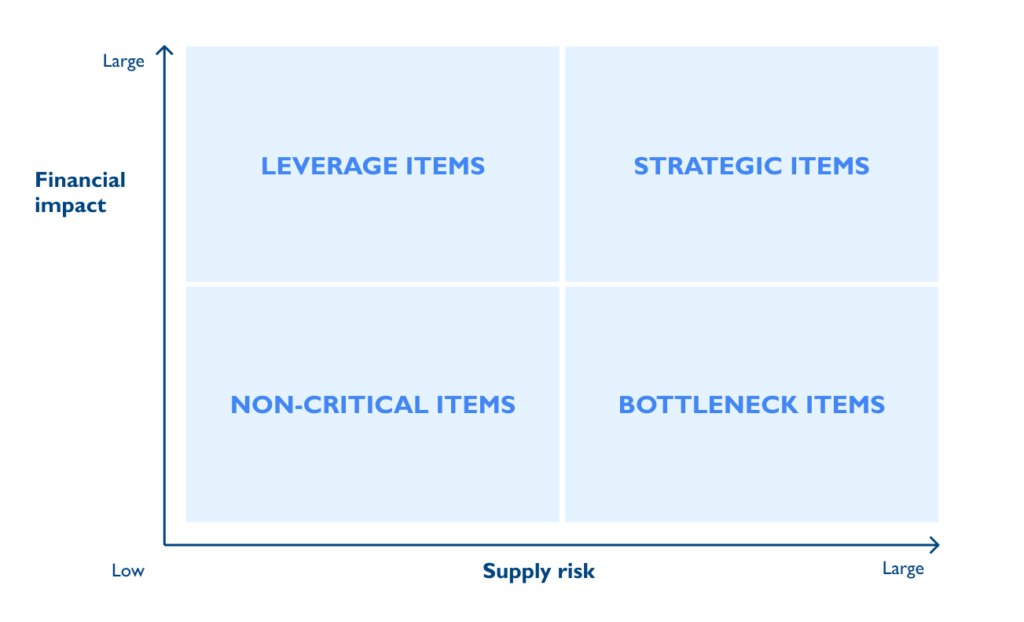
Kraljic Matrix
A procurement strategy is thus based on a thorough analysis of the existing situation at a company and its desired development/future expectations and of the environment: customers, suppliers/supply market, regulations and also the society in which the organization operates.
Usually this analysis takes place in a limited or partial way. Finally, a historical situation has arisen that is a given for many, e.g., the existence/non-existence of a purchasing department, the extent of its responsibilities, the way it works with suppliers, etc.
The analysis that does get done should be based on all relevant data/data and interviews. In short, the procurement strategy must be tailored to the specific needs of the organization and the sector in which it operates. In order to develop a procurement strategy that helps the organization be successful.
Free whitepaper
Project Procurement in the Machine Building Sector
What does a procurement strategy include?
A procurement strategy leads to choices regarding topics such as:
- The budgeting (funding) of the procurement organization.
- the building of the procurement organization itself, the training and supervision of employees after they start, etc.
- the delineation of responsibilities between the purchasing department and surrounding departments and idem for individual functions
- the division of total purchasing into manageable categories, both indirect and direct purchasing categories, using in part the Kraljic matrix for this purpose
- the distribution of these categories among officers within the organization, e.g. IT procurement is done by IT itself, but the direct procurement categories are divided among the procurement staff
- the supplier policy per category (single or multi vendor) and if multi vendor how do the suppliers relate to each other (and why?)
- financial and authorization policies (payment terms, authorization levels, 3-way matching of invoices, etc.)
- how to select, contract and manage suppliers
- the processes to be used and how they will be designed, documented, kept up to date and how employees will work smoothly with them (be trained in them)
- what tools (including templates for contracts, RFQs, RFIs) and applications are needed for this, how are they selected, implemented and funded
- procurement targets and to whom those targets are assigned
If you want to evaluate your procurement strategy and see how it compares to best practices, Xentys can help. Xentys offers a range of procurement services, including strategic sourcing, procurement process optimization and supplier relationship management. Contact xentys today for more information.
Find a buyer through xentys
At xentys, your experienced procurement recruitment agency, we are happy to help you find the right professional for your procurement team. Send a message today and strengthen your purchasing department.
News

How to Successfully Negotiate as a Buyer in 2026
In the past, negotiation within procurement mainly revolved around securing the lowest possible price. That was certainly the case when I was a young buyer some 30 years ago. Since then, negotiation has become far more complex – like so many other things. Today, procurement is a strategic business function.

Supplier risk intelligence: why supplier risk management is more important than ever
The impact of geopolitical tensions, trade tariffs, sanctions, cyber threats, and supply chain disruptions A changing reality for procurement The environment in which procurement operates has fundamentally changed. Supply chains have become more international, more complex, and more dependent on a limited number of critical suppliers and regions. At the

The Hidden Costs of a Procurement Talent Shortage
How Understaffed Procurement Teams Lead to Burnout, Increased Operational Risks, and Reduced Strategic Impact A Growing Problem with an Underestimated Impact In many organizations, procurement is under increasing pressure. Supply chains have become more volatile, dependency on suppliers are growing, and business expectations are shifting toward speed, flexibility, and strategic

The growing risk gap in procurement
Today, managing business risk is essential in the procurement industry. While for many years focus lied on cost control, contract management and early involvement in projects, the landscape has shifted significantly. Geopolitical tensions, disruptions in international supply chains, price volatility, and stricter regulations mean that organizations are facing more uncertainty